LIVER STUDIES IN PEOPLE WITH HIV
Tesamorelin Liver Fat Findings in People With HIV
Studies checked liver fat, swelling, and scars. Each adult had HIV plus a fatty liver unrelated to drinking alcohol.
What did the liver studies find?
The studies measured liver fat, swelling, and scarring. NAFLD is the doctors’ name for fatty liver when drinking is not the cause. Adults in this work had both HIV and NAFLD, and tesamorelin lowered the fat seen on liver scans. Blood tests and liver samples also showed calmer immune work and fewer signs tied to scars. These test changes do not prove that anyone felt healthier. For you, HIV in every study member is the main limit. The results don’t cover most people with fatty liver, and FDA approval does not include this use.
How much liver fat did tesamorelin reduce?
Liver scans improved in the adults studied with HIV. One study followed 50 people and found a liver-fat drop of 2.9%. Belly scans also showed an average organ-fat loss of 42 cm², or square centimeters [3]. In 2026, reviewers brought five studies with comparison groups together and found a 4.28% average liver-fat drop [15].
Another study followed a hormone that helps control how the body uses food. Both the hormone level and liver fat went down. One liver blood test improved, as did FIB-4, a score doctors use to estimate liver scars [7]. The study saw the changes together but could not tell which change led to another. This finding still applies only to HIV-related fatty liver in NAFLD.
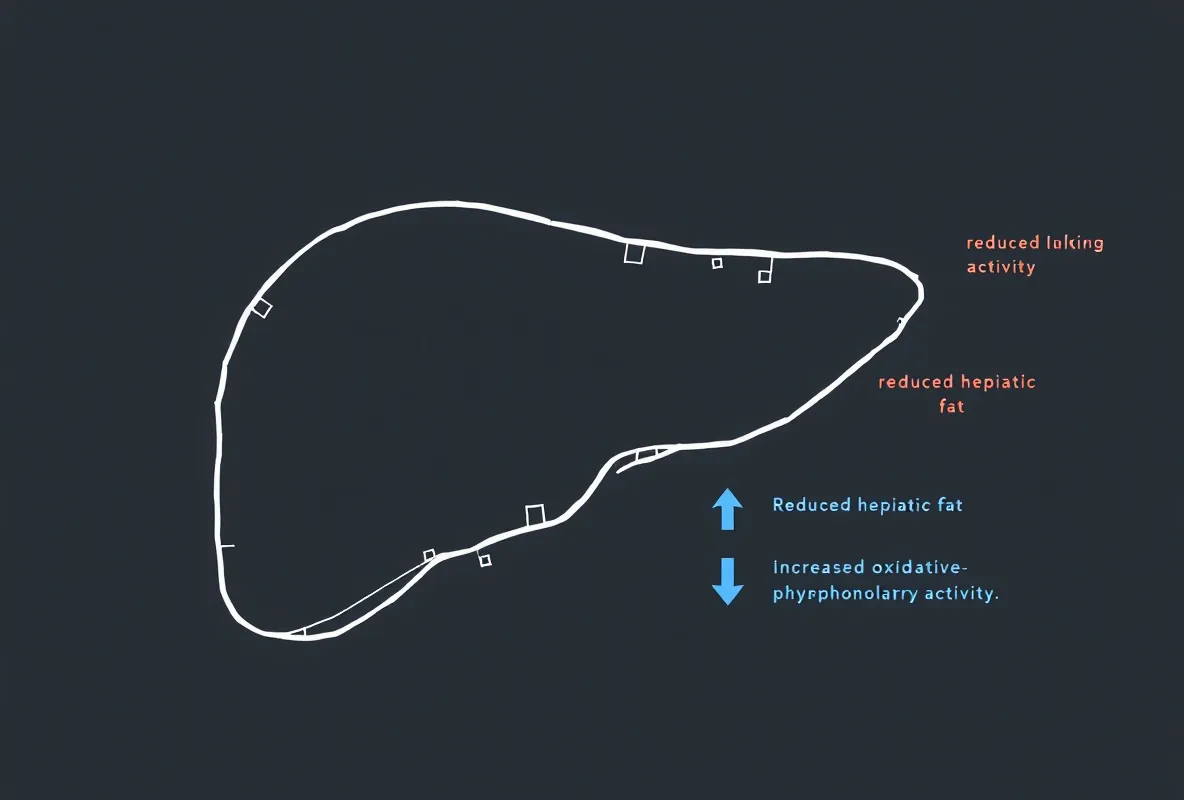
What changed inside the liver with tesamorelin and NAFLD?
People with HIV and NAFLD took tesamorelin for up to 12 months. Blood tests found lower levels of 13 proteins tied to immune-system work, with none rising. Liver samples also showed less immune activity [6]. These test results alone could not show whether people felt better.
Other blood tests found lower protein levels tied to new blood vessels, swelling, and scar tissue. All three proteins studied in detail fell, while larger drops in two went with better liver scores [8]. These findings may help explain the lower liver fat seen on scans. We don’t know if people outside this group would have the same response.
Could tesamorelin treat non-alcoholic fatty liver disease?
Tesamorelin might help fatty liver, but that use is still being studied. Liver scans showed a 2.9% drop among adults with HIV [3]. A 2026 review put the average drop at 4.28% [15]. Liver samples also had less immune activity and fewer signs tied to scar tissue [6][8]. The drug lacks FDA approval for fatty liver. All these findings came from people with HIV-related fatty liver.
What did liver samples show about scarring?
A study compared tesamorelin with placebo in 61 adults with HIV and NAFLD. Doctors took more than one liver sample. At the start, 43% had scars, and this group carried more fat near the belly organs. With each added 25 cm², or square centimeters, of organ fat, the odds of worsening scars at the 12-month review rose 37% [9]. This was an increase in odds, not in a person’s starting chance. The starting amount of organ fat helped predict worsening, but the first liver sample did not.
Blood tests found 20 proteins at higher levels when scarring was worse. One helps reshape tissue, one helps control growth, and one was collagen, the strong protein in scar tissue [10]. The first two carry the lab numbers 2 and 7, but those numbers don’t change what the finding means. The proteins also rose with more organ fat and poor sugar use. These links don’t prove that tesamorelin can stop scarring.
Who do these liver findings not cover?
Every liver-fat number here came from people with HIV. The FDA approved tesamorelin only for belly fat tied to HIV-related body changes [5]. It did not approve the drug for NAFLD. MASLD is a newer name doctors use for much the same kind of fatty liver. If you don’t have HIV, a large study has not proved the same result. Fatty-liver use remains off-label and is still being studied [12].